
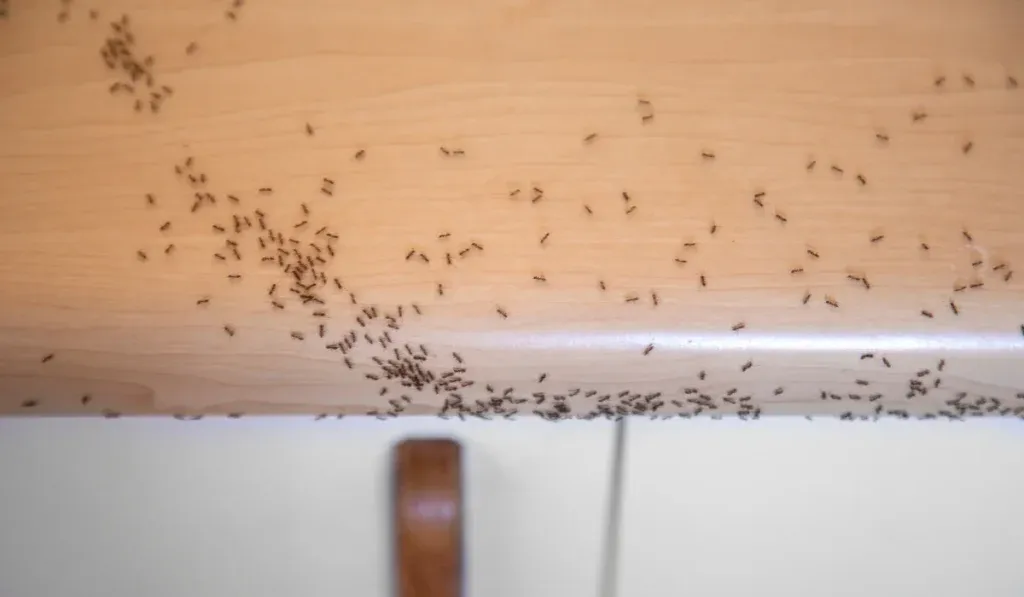
You head into the kitchen for your morning coffee and notice a line of ants making themselves right at home on your countertops. If you’re suddenly seeing ants and wondering what’s going on, you’re not alone.
Around here in the Big Horn Basin and Billings, it’s common for homeowners to experience a sudden spike in ant activity—especially during certain times of the year.
Let’s break down the reasons behind these unexpected ant invasions and how you can get ahead of the problem.
Key Takeaways
- A sudden ant problem often starts when temperature swings or storms drive ants inside through cracks and crevices.
- Easy food sources like crumbs, pet food, or spills will bring ants inside and quickly lead to infestations.
- Nearby nests in wall voids or tree stumps allow black ants or carpenter ants to easily invade your home.
- DIY efforts can backfire and scatter ants so pest control pros are often needed to stop the infestation completely.
Change in Weather or Temperature
Ant colonies don’t just hang out in one place year-round. Changes in weather—especially temperature swings—can drive them indoors.
- In spring, worker ants get busy, heading out in search of food and water sources.
- In colder months, some types of ants may seek shelter inside your home.
So, if we’ve had a rainstorm, heatwave, or cold snap recently, that could be why you’re seeing an uptick in activity.
Keep an eye out around baseboards, window sills, and door frames—common entry points they use to sneak inside.
Food Sources Attracting Ants
Ants are always in search of food. If they find something easy—like pet food left out, crumbs on countertops, or spills in the pantry—they’ll mark the spot with pheromone trails, calling in reinforcements.
Before you know it, you’ve got an ant infestation on your hands.
To keep them out, clean up any spills quickly and store your food in sealed containers or airtight containers. Don’t forget to pick up pet food dishes after feeding time.
Nearby Ant Nests or Ant Colonies
Seeing big black ants in your home? You might have carpenter ants nearby—or worse, nesting inside your walls. They often build their ant nest in damp wood, especially in wall voids or around leaky windows.
If you’re spotting black carpenter ants, it’s a good sign the colony is well established and possibly damaging the structure of your home.
Small black ants or tiny black ants can also build colonies around your property, especially under tree stumps or yard debris.
From there, it’s just a short trip inside when they need resources.
Easy Access Through Entry Points
Ants don’t need much space to get inside. Cracks in the foundation, gaps around pipes, and even the smallest crevices around doors and windows can be used as entry points. Once inside, they follow ant trails along baseboards and other hidden paths.
Grab some caulk and seal those gaps. Pay special attention to spots around window sills and exterior walls—common access points for them and other pests like termites or even bed bugs.
Water Sources Inside the Home
Just like us, ants need water to survive. Leaky pipes, standing water, or condensation under sinks can attract them fast. Carpenter ants, especially, are drawn to moisture and can often be found around bathrooms, kitchens, and laundry areas.
Fix those leaks and dry out problem areas to cut off this attractant.
DIY Treatments Stirred Them Up
Tried to kill ants with DIY solutions like borax or diatomaceous earth? Sometimes these methods can scatter them instead of solving the pest problem.
If you’re seeing ants pop up in new spots, it could mean the colony sensed a threat and split up—a common response from certain species of ant.
DIY ant baits and commercial insect repellents can be a great first step, but if it’s not working, it might be time to call in a pest control professional.
When to Call a Pest Control Company
Ants may be small, but dealing with a pest problem can take up your whole Saturday. We know you’re capable of handling it yourself—but why spend your free time chasing them when you could have a pest control service handle it for you?
At Kodiak Pest Control, we specialize in pest management that goes beyond surface-level ant control. We don’t just kill ants; we treat the source, disrupt scent trails, and help prevent future infestations.
Whether it’s little black ants or black carpenter ants, we’re the pros who get the job done. Let us save you the hassle.
Contact us now, and get back to focusing on what matters most.




