
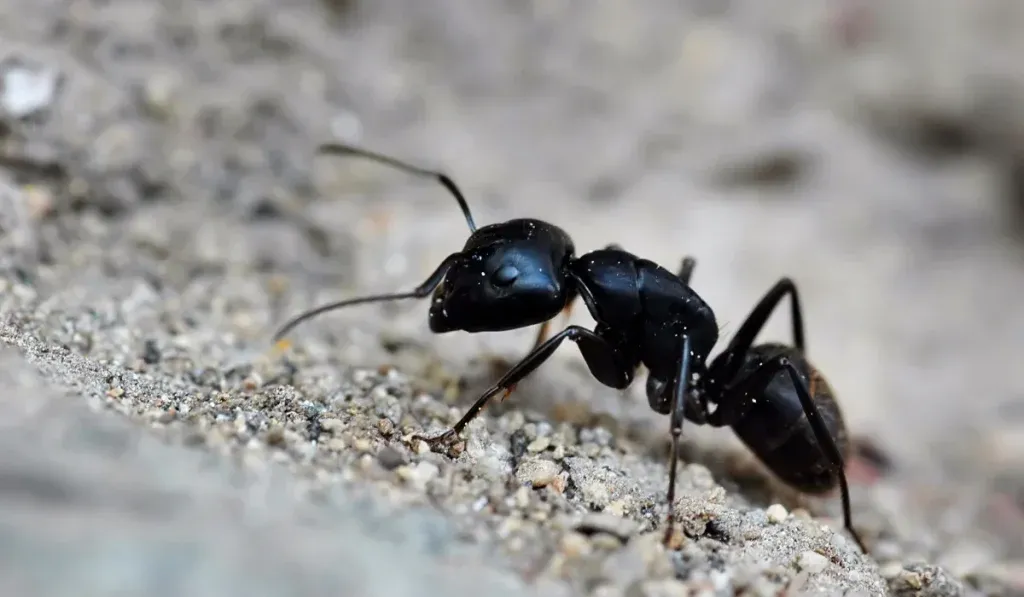
Black ants can quickly become a problem when they invade your home, forming long ant trails across your countertops and floors. Whether you’re dealing with a few stray worker ants or a full-blown ant infestation, pest control requires a combination of methods to get rid of ants effectively.
Here’s a step-by-step guide to eliminating black ants and keeping them from coming back.
Key Takeaways
- Some black ants are just a nuisance, but carpenter ants can damage wood and cause serious structural problems.
- Ants follow scent trails to food, so sealing cracks, cleaning spills, and removing food sources can stop them.
- Natural repellents like vinegar and peppermint oil help, but bait traps with borax work best to kill entire colonies.
- A professional exterminator can eliminate ants and prevent them from returning, especially when the infestation is severe.
How to Get Rid of Black Ants in 8 Steps
No one wants to deal with black ants marching through their kitchen or finding their way into the pantry. The good news? You don’t have to put up with them.
Here’s how to do it.
Step 1: Identify the Type of Ants You’re Dealing With
The first step in effective pest management is identifying the species of ants in your home. Not all small black ants behave the same way—some, like little black ants and sugar ants, are mostly a nuisance.
Unlike termites that feed on wood, larger carpenter ants, which are sometimes black, can burrow into wood and cause structural damage.
Step 2: Locate Ant Trails and Entry Points
Black ants follow pheromone trails that help guide worker ants to food sources.
To stop an infestation, trace these scent trails back to their entry points. Check crevices along baseboards, windowsills, and doors. Common ant entry points also include cracks in walls, gaps in floors, and even plumbing lines.
Sealing off these areas with caulk helps prevent new ants from coming inside.
Step 3: Remove Food Sources and Clean Up Your Home
Black ants are constantly searching for food.
To get rid of ants, remove their food sources by keeping your home clean. Wipe down countertops with dish soap and hot water to eliminate pheromone trails. Store pet food in airtight containers, and avoid leaving dirty dishes in the sink overnight.
Keep sugar, flour, and other dry goods in sealed containers to make your kitchen less appealing to ants.
Step 4: Use Natural Remedies to Repel Ants
If you’re looking for natural ways to deter black ants, several DIY solutions can be effective. In a spray bottle, white vinegar mixed with equal parts water can be sprayed along ant trails to disrupt their scent.
Essential oils, such as peppermint oil, can be applied to cotton balls and placed near entry points to repel ants. In fact, research has even shown that some plant-based oils, like Murraya paniculata, work well at repelling them.
Diatomaceous earth, a fine powder made from fossilized algae, can be sprinkled in cracks and crevices to dehydrate and kill these pests on contact.
Step 5: Set Up Ant Bait Stations
Instead of only repelling ants, using ant bait is a more effective long-term solution.
Commercially available ant traps contain slow-acting ingredients like borax or boric acid, which ants take back to the ant colony, eventually killing the entire colony.
Place bait stations near ant trails and avoid spraying repellent in the same area, as it can deter ants from taking the bait.
Baking soda, when mixed with powdered sugar, can also act as a DIY ant bait.
The sugar attracts the ants, while the baking soda disrupts their digestive system, helping to eliminate them. This is another natural alternative that can be used alongside borax-based bait traps for added effectiveness.
Step 6: Destroy the Ant Nest
If you’ve located the ant nest, you can eliminate it directly. Pouring boiling water into an ant nest outside can be an effective way to kill the colony.
Another method is to apply granules or bait traps near the nest entrance.
Keep ants from rebuilding by removing aphids from your plants, as ants are attracted to the honeydew they produce.
Step 7: Prevent Future Infestations
Once you’ve gotten rid of the ants, take steps to keep them from coming back.
Seal cracks and crevices with caulk, clean up crumbs and spills immediately, and store all food in airtight containers. Regularly check windowsills, baseboards, and countertops for signs of new ant activity.
Other pests like fire ants and fleas can also invade your home, so maintaining a clean and sealed environment helps prevent multiple pest issues.
Step 8: Call an Exterminator
If DIY ant killers aren’t enough, or if you’re dealing with a large black infestation, it might be time to call a professional pest control service in Greybull.
At Kodiak Pest Control, we specialize in professional black ant control that goes beyond quick fixes. We don’t just get rid of the black ants you see. We target the entire colony, seal up entry points, and help prevent future infestations.
If you’re tired of battling black ants on your own, let us handle it for you. Give us a call today, and we’ll take care of the problem so you can get back to enjoying your home—ant-free.




